Off-Page SEO: A Beginner’s Guide to Building Website Authority
SEO does not stop after optimizing your website.
You may have researched the right keywords, created useful content, improved your pages, and worked on the technical side of your website. But there is another part of SEO that happens outside your own website.
This is called Off-Page SEO.
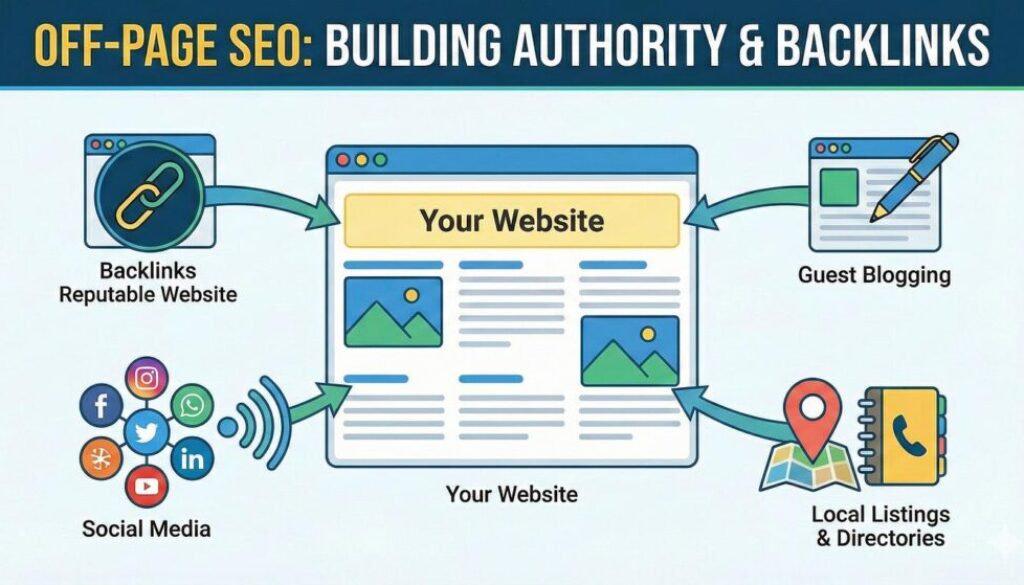
Off-page SEO is about building trust, authority, and recognition for your website through activities that happen outside your website. Backlinks are an important part of it, but off-page SEO is not limited to getting links.
For a beginner, the easiest way to understand it is this:
On-page SEO improves what is on your website. Technical SEO improves how your website works. Off-page SEO helps build your website’s reputation outside it.
What Is Off-Page SEO?
Off-page SEO refers to activities performed outside your website that can help improve its authority, reputation, and visibility in search engines.
Some common off-page SEO activities include:
- Building quality backlinks
- Earning online mentions
- Digital PR
- Guest contributions
- Business listings and citations
- Social media visibility
- Reviews and reputation building
- Creating content that others want to reference
The main idea is not to collect as many links or mentions as possible.
It is to build genuine connections and signals that show your website is useful and trustworthy.
Why Is Off-Page SEO Important?
Think about two websites covering the same topic.
One website has useful content, but hardly anyone references it.
The other website has useful content and is also mentioned or linked to by relevant websites.
Those external references can provide additional signals about the second website’s presence and reputation.
This is one reason Off-Page SEO matters.
A good off-page SEO strategy can help with:
- Website authority
- Search visibility
- Referral traffic
- Brand awareness
- Online reputation
- Building relationships with relevant websites and businesses
However, off-page SEO should work together with good content and a technically healthy website.
Getting backlinks cannot compensate for a website that provides a poor experience or unhelpful content.
What Are Backlinks?
A backlink is a link from another website to your website.
For example, imagine a digital marketing website publishes an article about SEO and links to your guide about keyword research.
That link is a backlink to your website.
Backlinks can help people discover your content and can also contribute to how search engines understand the authority and relevance of pages.
But there is an important point:
Not all backlinks have the same value.
One relevant, genuine link can be more useful than a large number of unrelated or low-quality links.
Quality Matters More Than Quantity
A common beginner mistake is thinking:
“The more backlinks I get, the better my SEO will be.”
That’s not a good way to approach link building.
Imagine you have a website about digital marketing.
A link from a relevant marketing, business, education, or industry website may make more sense than dozens of links from unrelated websites.
When thinking about backlinks, consider:
- Is the website relevant?
- Is the link placed naturally?
- Would the link be useful to readers?
- Is the website trustworthy?
- Is the content genuine?
The goal should be to earn useful links, not simply collect them.
How Can You Get Backlinks Naturally?
You don’t always need to ask hundreds of websites for links.
A better starting point is creating something worth referencing.
For example, you could create:
- Useful guides
- Original research
- Practical checklists
- Helpful tutorials
- Case studies
- Industry resources
- Infographics
- Detailed beginner guides
When your content genuinely helps people, there is a better chance that other websites may reference it.
This is where your previous blogs can become useful.
Instead of creating content only to target keywords, create resources that answer real questions.
Guest Posting and Off-Page SEO
Guest posting means contributing an article to another website.
For example, you might write an educational article about beginner SEO for a relevant website and, where appropriate, include a link back to a useful resource on your own website.
The important part is relevance.
Guest posting should be about contributing something useful to another audience, not publishing the same article across dozens of websites just to obtain backlinks.
If you contribute an article, make it genuinely useful and original.
Digital PR and Online Mentions
Off-page SEO can also involve getting your brand or business mentioned online.
For example, a business may be mentioned in:
- Industry publications
- Local news websites
- Business articles
- Interviews
- Podcasts
- Online events
- Community websites
These mentions can increase awareness even when they don’t always result in a direct backlink.
For a personal brand, building recognition can be just as important as building links.
Social Media and Off-Page SEO
Social media is often discussed alongside off-page SEO, but it is important to understand the difference.
Sharing your website content on platforms such as Instagram, LinkedIn, or other social networks can help more people discover it.
That can lead to:
Content → Social visibility → More people discover it → Someone references it → Potential backlink
Social media can therefore support your broader off-page strategy by increasing content distribution and brand visibility.
For example, if you publish an SEO article on your website, you can share a useful takeaway from the article on LinkedIn or Instagram and direct interested people to the full article.
Online Reviews and Reputation
For businesses that serve customers directly, reviews are an important part of online reputation.
People often look at reviews before contacting a business.
Encouraging genuine customers to leave honest reviews can help establish trust with potential customers.
Don’t create fake reviews or ask people to post misleading feedback.
A strong online reputation should come from real customer experiences.
Local Business Listings
Although you already covered Local SEO earlier in your blog series, business listings are also connected to your broader online presence.
For a local business, keeping important business information consistent across relevant platforms can help people find and recognize the business.
Important information may include:
- Business name
- Address
- Phone number
- Website
- Business category
- Opening hours
Keep the information accurate and update it when something changes.
Off-Page SEO for Personal Brands
Off-page SEO is not only for companies.
It can also be useful when building a personal professional brand.
For example, if you are establishing yourself as a Digital marketing strategist in Kannur, your online presence should not depend only on your own website.
You can gradually build visibility through:
- LinkedIn content
- Professional communities
- Industry discussions
- Guest articles
- Relevant collaborations
- Interviews
- Portfolio mentions
- Educational content
The idea is to make your name and expertise discoverable across relevant online spaces.
Don’t try to appear everywhere at once.
Start with platforms and communities where your target audience actually spends time.
How to Build an Off-Page SEO Strategy
You don’t need a complicated strategy when you’re just starting.
A simple process can look like this:
Step 1: Create Useful Content
Start with content that genuinely answers questions or solves problems.
Step 2: Identify Relevant Websites
Look for websites, publications, communities, and businesses related to your topic.
Step 3: Build Genuine Relationships
Instead of immediately asking for backlinks, participate in relevant discussions and create useful connections.
Step 4: Promote Your Content
Share your articles through appropriate channels such as LinkedIn and other relevant platforms.
Step 5: Look for Collaboration Opportunities
Consider guest contributions, interviews, expert discussions, podcasts, or other relevant opportunities.
Step 6: Monitor Your Backlinks
Keep track of the websites linking to your content and look for unusual or potentially harmful patterns.
Step 7: Keep Creating Useful Resources
Off-page SEO is not a one-time activity.
Consistently useful content gives people more reasons to reference your website.
Common Off-Page SEO Mistakes
Buying Large Numbers of Backlinks
Buying links in bulk simply to manipulate rankings can create problems rather than building genuine authority.
Getting Links From Unrelated Websites
A backlink should make sense in the context where it appears.
Using the Same Anchor Text Everywhere
Repeatedly using the exact same keyword-rich anchor text can make your link profile look unnatural.
Spamming Blog Comments
Leaving generic comments on websites just to place a link is not a useful SEO strategy.
Focusing Only on Backlinks
Off-page SEO is broader than link building. Brand visibility, reputation, relationships, and content promotion also matter.
Ignoring Content Quality
If your website doesn’t have useful content, there is little reason for other websites to reference it.
Off-Page SEO vs On-Page SEO
It is useful to understand the difference between the two.
| On-Page SEO | Off-Page SEO |
|---|---|
| Happens mainly on your website | Happens mainly outside your website |
| Optimizes content and page elements | Builds external visibility and authority |
| Includes headings and keywords | Includes backlinks and online mentions |
| Includes internal linking | Includes external references |
| Focuses on page relevance | Focuses on reputation and external signals |
Neither should be treated as a replacement for the other.
A strong SEO strategy combines both.
How Off-Page SEO Connects With Your Previous SEO Work
Your previous blogs have already covered several important parts of SEO.
Keyword Research helps you understand what people search for.
Search Intent helps you understand what they expect from the search.
On-Page SEO helps you optimize your actual webpages.
Technical SEO helps make sure your website has a strong technical foundation.
Now Off-Page SEO adds the external side of the strategy.
The complete process becomes:
Keyword Research → Search Intent → On-Page SEO → Technical SEO → Off-Page SEO → Performance Monitoring
This is a much more complete way to think about SEO than focusing only on keywords.
A Simple Off-Page SEO Checklist
Before starting an off-page SEO campaign, ask yourself:
☐ Does my website have useful content?
☐ Are my important pages properly optimized?
☐ Is my website technically healthy?
☐ Am I creating content people would actually want to reference?
☐ Am I targeting relevant websites and communities?
☐ Are my backlinks coming from genuine sources?
☐ Am I avoiding spammy link-building methods?
☐ Am I promoting my content consistently?
☐ Am I building a genuine online reputation?
☐ Am I monitoring my website’s backlink profile?
This checklist gives you a simple starting point without making SEO unnecessarily complicated.
Final Thoughts
Off-page SEO is about building trust and visibility beyond your own website.
Backlinks are an important part of it, but they are not the whole story.
Creating useful content, building genuine relationships, earning relevant mentions, sharing your expertise, and developing a trustworthy online presence can all contribute to a stronger off-page strategy.
Don’t chase hundreds of backlinks just because a tool tells you that you need more.
Focus on creating something useful enough that people have a real reason to mention, share, or reference it.
For someone building a professional online presence as a Digital marketing strategist in Kannur, this approach can gradually help connect the website with a wider digital presence.
SEO takes time. Build it properly instead of trying to find shortcuts.