
How Does Digital Marketing Work? A Simple Step-by-Step Guide
Digital marketing can look complicated when you first start learning about it. You have to understand websites, search engines, social media platforms, ads, content, analytics, and much more.
But when you look at the process step by step, it becomes much easier to understand.
Digital marketing is mainly about connecting a business with the people who are most likely to need its products or services. The platform may change, but the basic idea remains the same: understand the audience, provide something useful, reach the right people, and measure the results.
Where Does Digital Marketing Start?
Digital marketing should not start with choosing an Instagram post idea or creating an advertisement.
It should start with understanding the business and its audience.
Before creating a strategy, a business needs to think about questions such as:
- What does the business offer?
- Who are the ideal customers?
- What problems do they have?
- What are they searching for online?
- Where do they spend their time?
- What makes this business different?
These questions help create a clearer direction.
Without understanding the audience, even good content can reach the wrong people.
Step 1: Understand Your Target Audience
The target audience is the group of people a business wants to reach.
For example, a local bakery may want to reach people looking for cakes for birthdays, weddings, celebrations, or other occasions.
Understanding the audience helps a business decide what type of content to create, which platform to use, and what message to communicate.
The better you understand the audience, the easier it becomes to create marketing that feels relevant instead of random.
Step 2: Build a Strong Online Presence
Once the audience is clear, the next step is creating a place where people can learn more about the business.
This may include:
- A professional website
- Google Business Profile
- Social media profiles
- Useful blog content
- Customer reviews
For many businesses, the website becomes the main place where visitors can find information about products, services, contact details, and the business itself.
A good online presence should make things simple for visitors. They should quickly understand what the business offers and what they can do next.
Step 3: Choose the Right Digital Marketing Channels
Every business does not need to use every digital platform.
A business should choose channels based on its audience and goals.
For example:
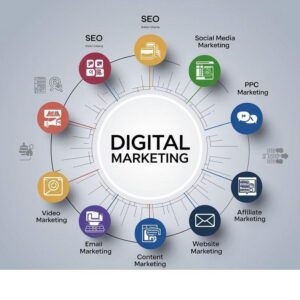
SEO can help people discover a website through search engines.
Social Media Marketing can help a business communicate with its audience and build engagement.
SEM and paid advertising can help businesses reach people through targeted advertisements.
Content Marketing can provide useful information and answer customer questions.
The right combination depends on the business.
More platforms do not automatically mean better marketing.
Step 4: Create Useful Content
Content is an important part of digital marketing.
But creating content simply because a business needs to “post something” is not a strong strategy.
Good content should have a purpose.
It could:
- Answer a common question
- Explain a product
- Solve a customer problem
- Share useful information
- Show how something works
- Help people make a decision
For example, instead of repeatedly posting “Buy our product,” a business could create content explaining how to choose the right product, common mistakes to avoid, or useful tips related to it.
This gives people a reason to pay attention.
Step 5: Improve Search Visibility With SEO
Search Engine Optimization helps people discover a website when they search for relevant information.
SEO starts with understanding what people are searching for.
This includes:
- Keyword research
- Useful website content
- Clear page titles
- Proper headings
- Internal linking
- Technical improvements
- Mobile-friendly design
- Good user experience
For local businesses, Local SEO can be particularly useful.
For example, someone searching for a service in Kannur may use location-based searches. Having relevant website content and a properly optimized local presence can help a business become more visible to those potential customers.
Step 6: Connect With People Through Social Media
Social media gives businesses a direct way to communicate with their audience.
But social media marketing is more than uploading posts regularly.
Businesses need to understand what their audience actually wants to see.
Different types of content can serve different purposes:
- Educational content can provide value
- Behind-the-scenes content can make a brand feel more personal
- Product content can explain an offer
- Customer content can build trust
- Short-form videos can increase engagement
Consistency matters, but useful content matters more.
Step 7: Use Paid Advertising When It Makes Sense
Organic marketing can take time. Paid advertising can help a business reach a specific audience more quickly.
Search ads and social media ads can be targeted based on factors such as interests, location, behaviour, keywords, and other audience characteristics.
However, spending money on advertisements does not guarantee results.
The advertisement needs the right audience, message, offer, landing page, and objective.
A poorly planned campaign can spend money without generating meaningful results.
Step 8: Measure What Is Working
One of the biggest advantages of digital marketing is that many results can be measured.
Depending on the goal, businesses can track:
- Website visitors
- Search traffic
- Social media engagement
- Leads
- Clicks
- Conversions
- Advertising performance
These numbers help businesses understand what is working and what needs improvement.
For example, if a blog receives search traffic but very few visitors contact the business, the problem may not be traffic. The website content or call to action may need improvement.
Step 9: Test and Improve
Digital marketing is not something you create once and leave untouched.
Audience behaviour changes. Platforms change. Search trends change. Competitors change.
That means businesses need to review their performance and make improvements over time.
A campaign that does not work as expected is not necessarily a complete failure. It can provide useful information about what needs to change.
Testing different content, audiences, keywords, messages, or advertising approaches can help find better results.
A Simple Digital Marketing Process
The complete process can be understood like this:
Understand → Plan → Create → Reach → Engage → Convert → Measure → Improve
Each stage supports the next one.
If the audience is unclear, the content may be weak.
If the content is good but nobody can find it, SEO or promotion may be needed.
If people visit the website but do not take action, the website experience may need improvement.
This is why digital marketing works best as a connected strategy.
Digital Marketing for Local Businesses in Kannur
Local businesses have a valuable opportunity to connect with people who are actively searching for nearby products and services.
A business in Kannur can use a combination of Local SEO, social media, website content, customer reviews, and targeted advertising to build its online presence.
The strategy should depend on the business rather than following the same approach for everyone.
A Digital Marketing Strategist in Kannur can help a business understand its audience, identify suitable digital channels, plan content, improve online visibility, and measure marketing performance.